
Basketball Betting Analysis
Basketball Point Spread Betting: Complete Guide 2026
 Available in US
Your statistical edge in basketball betting.

What Every UK Punter Needs to Know About Point Spreads
The Core Mechanic
Point spreads level the betting field by assigning a handicap — favourites must win by more than the spread, underdogs can lose by less than the spread and still cash your bet.
Break-Even Reality
Standard -110 odds (1.91 decimal) require a 52.4% win rate just to break even. Professionals rarely sustain above 57-58% long-term — the margins are thinner than most expect.
Home Court Value
The NBA baseline is 3 points for home advantage, but individual teams range from barely 1 point to 7+ points. Generic adjustments miss where real edges live.
UK Market Context
British gambling generates £16.8 billion annually, with 2025 reforms tightening oversight. Licensed operators offer NBA spreads on every game with improving liquidity.
Basketball point spread betting changed how I think about the game entirely. Nine years ago, I sat in a cramped flat in Manchester, staring at an NBA line I couldn't make sense of. The Lakers were listed at -7.5, and I had no idea what that minus sign meant or why anyone would bet on a team "giving away" points. That confusion cost me money that night — and sparked an obsession that turned into a career.
Today, the UK gambling industry generates £16.8 billion in gross gambling yield annually, with online betting growing faster than any other segment. Meanwhile, the NBA market itself is valued at nearly $13 billion and climbing. British punters are discovering what American bettors have known for decades: basketball offers some of the most dynamic betting opportunities in sport, and the point spread sits at the heart of it all.
This guide exists because I've watched too many smart people make the same mistakes I made. They understand football handicaps but get thrown by American terminology. They know the game but don't grasp how bookmakers build their lines. They've heard "cover the spread" in podcasts without truly understanding what it means for their slip.
I'm going to walk you through everything — from the basic mechanics that tripped me up in that Manchester flat to the mathematical realities that separate recreational bettors from those who actually turn a long-term profit. Whether you're placing your first NBA bet or looking to sharpen an existing approach, the principles here are the foundation everything else builds on. Point spread betting isn't complicated once you see the logic behind it. My job is to make that logic impossible to miss.
What Is Point Spread Betting in Basketball?
The first time I tried explaining point spreads to my brother, I made it far too complicated. He stopped me mid-sentence and asked, "So they're just trying to make both teams equally attractive to bet on?" Exactly. That's the entire concept in one question.
Point spread betting is the most popular way to wager on NBA games, and the logic is beautifully simple once it clicks. Bookmakers know that if they offer a straight-up bet on the Boston Celtics against a struggling team, everyone would pile onto Boston. The spread exists to level the playing field — not on the court, but on the betting slip.
Point Spread — a handicap assigned to teams that must be added to or subtracted from their final score to determine the betting outcome. The favourite "gives" points (shown with a minus sign), while the underdog "receives" points (shown with a plus sign).
Here's how it actually works. When you see a line like Celtics -6.5 vs Hornets +6.5, the bookmaker is saying: "We think Boston will win by about seven points. Want to bet otherwise?" If you back Boston at -6.5, they need to win by 7 or more for your bet to cash. If you take Charlotte at +6.5, you win as long as they don't lose by more than 6. The Hornets could lose by 6 and you'd still collect.
Example: Lakers at Nuggets
Lakers: +4.5 (1.91)
Nuggets: -4.5 (1.91)
Final Score: Nuggets 112, Lakers 109
Nuggets win by 3 points. Lakers +4.5 bettors win (109 + 4.5 = 113.5 beats 112). Nuggets -4.5 bettors lose (needed a win by 5+).
The spread creates tension in games that would otherwise be one-sided. I've watched hundreds of fourth quarters where the actual winner was never in doubt, but the spread outcome hung on every possession. That Nuggets-Lakers example? The game itself was competitive, but the real drama for spread bettors came down to a single missed free throw in the final minute.
What makes this bet type so dominant in basketball? The NBA averages around 220 points per game across both teams, with constant scoring and lead changes. Football might see a handful of scoring events; basketball offers dozens. That high-scoring nature means spreads are precise — you'll rarely see whole-number lines like -5, because bookmakers can fine-tune to -4.5 or -5.5 to avoid ties.
Point spread betting accounts for the overwhelming majority of NBA wagering volume, with odds typically set at -110 on both sides. That -110 figure (decimal 1.91) matters more than most beginners realise, and I'll explain exactly why when we get to the mathematics section. For now, understand that the spread is your entry point into serious basketball betting — everything else builds from here.
UK Handicap vs American Spread: Terminology Differences
I spent my first year of NBA betting genuinely confused about why British sites called it "handicap betting" while American podcasts always said "spread." I assumed there was some subtle difference I was missing. There isn't. They're the same thing with different labels.
This terminology gap trips up more UK bettors than you'd expect. You might be comfortable with football handicaps — giving or receiving goals — but then freeze when an American tout talks about "laying the points" or "taking the dog against the number." It's all the same mechanics, just dressed in different vocabulary.
| UK Term | US Term | Meaning |
|---|---|---|
| Handicap | Spread / Point Spread / Line | The points advantage given to level the bet |
| Giving points | Laying points | Betting the favourite to win by more than the spread |
| Receiving points | Taking points | Betting the underdog with the points cushion |
| Void / Stake returned | Push | The margin lands exactly on the spread |
| Accumulator | Parlay | Multiple selections combined into one bet |
| Against the spread (universal) | ATS | Performance measured against the handicap, not outright wins |
The most important practical difference? Odds presentation. UK sites typically default to decimal (1.91) or fractional (10/11), while American content shows moneyline format (-110). When someone says a bet is "-110 on both sides," they mean you're risking 110 units to win 100 — which converts to 1.91 in decimal, or roughly 10/11 fractional. Same juice, different packaging.
My advice: pick whichever format makes intuitive sense to you, but learn to read all three. American analysis dominates NBA betting content, and you'll handicap yourself (pun intended) if you can't follow the numbers. Most UK platforms let you toggle between formats in your settings — I keep mine on decimal because the maths is simpler when calculating returns.
How NBA Point Spreads Work: Step-by-Step Mechanics
Let me tell you about the most valuable lesson I've learned in nine years of basketball betting: the spread isn't a prediction. Bookmakers aren't trying to guess the exact margin of victory. They're trying to attract equal money on both sides so they profit from the juice regardless of outcome.
The spread-setting process starts with power ratings — proprietary models that assign a point value to each team's strength. When the Celtics play the Pistons, oddsmakers compare these ratings, factor in home court advantage (roughly 3 points on average), and produce an opening number. If Boston rates 8 points better than Detroit and plays at home, the opening line might be Celtics -11.
That opening line is just the starting point. Once betting markets open, the line moves based on where money flows. Sharp bettors — professionals with winning track records — often strike early, and their action carries more weight than casual bets. If sharp money hammers Detroit +11, the line might shift to Celtics -10 before tipoff.
Example: Tracing a Line Movement
Opening line: Warriors -5.5 vs Trail Blazers
Early sharp action: Money on Trail Blazers +5.5
Line moves: Warriors -5
Public betting: Heavy on Warriors (bigger name, better record)
Final score: Warriors 118, Trail Blazers 114
Warriors win by 4. Trail Blazers +5 bettors win. Warriors -5 bettors lose.

That 3-point home court figure isn't arbitrary. Jeff Sagarin's widely-cited ratings peg NBA home advantage at exactly 3.0 points on average, though individual arenas vary significantly. Denver's altitude makes their home edge closer to 4 or 5 points; some teams barely benefit from playing at home.
Same Teams, Different Lines
Celtics at Heat: Celtics -3.5
Heat at Celtics: Celtics -9.5
The 6-point swing reflects home court advantage for whichever team hosts.
NBA lines open around 24 hours before tipoff and move constantly. The line you saw this morning might be two points different by evening. Injury news, rest patterns, travel schedules — all of it gets priced in almost immediately.
The line builder
Oddsmakers do not guess a margin. They start with a power rating, add home court, subtract for rest and travel, adjust for who is unavailable, and post the number. This tool runs that same assembly line for you, then puts your number next to the market's and works out what the gap is actually worth — in points, in win probability, and in expected value at the price you have been offered.
Home team
Away team
—
How this model works
Building the line. Your line is the rating gap plus home court, plus the difference in rest situations, minus the points you have taken off each side for unavailable players. The rest figures are the commonly cited ones: roughly 2.25 points of degradation on the second night of a back-to-back, closer to 4 when travel is involved, and a small bonus for extended rest. Home court defaults to the 3.0-point league baseline, but the whole point of the field is that you should change it. A generic 3 applied to every arena is the single laziest adjustment in spread betting.
Turning points into probability. Actual NBA margins scatter around the true expected margin with a standard deviation of about 11.5 points, and that scatter is close enough to normal to model. That single number is what converts a point of edge into a probability of covering: near a coin-flip line, one point is worth roughly three and a half percentage points, which is why a two-point disagreement with the market moves you from 50% to about 57% and no further. The curve in the panel above is that distribution, centred on your line, with the shaded region being every margin that cashes your bet. Its area is your cover probability.
Expected value. The break-even rate at a standard price of −110 is 52.4%, not 50% — the juice is the whole reason. Expected value per pound is your cover probability multiplied by the decimal price, minus one. The shopping panel re-runs the same arithmetic at a better price and at half a point more of line, because those two levers usually move the result more than another hour of analysis will.
What the model does not do. It treats the line as continuous, so it does not price the push risk on whole-number spreads. It assumes your rating gap is honest, which is the assumption that breaks most often: if the number you type is just the market line with your feelings added, the tool will faithfully confirm your feelings. And it says nothing about whether a game is worth betting at all — a genuine edge on one game in twenty is a normal result, not a failure.
Reading NBA Odds as a UK Bettor: Decimal vs Fractional
I remember switching between three browser tabs my first season — one for the American podcast I was following, one for a fractional-to-decimal converter, and one for my betting account. These days, the numbers are second nature. Let me save you six months of confusion.
UK bookmakers typically display NBA odds in decimal format by default. Decimal odds show your total return including stake: odds of 1.91 mean a £10 bet returns £19.10 (your £10 stake plus £9.10 profit). Simple multiplication, no mental gymnastics required.
| Format | Standard Spread Odds | £100 Stake Returns | Profit on £100 |
|---|---|---|---|
| Decimal | 1.91 | £191.00 | £91.00 |
| Fractional | 10/11 | £190.91 | £90.91 |
| American | -110 | $190.91 (equiv.) | $90.91 (equiv.) |
American sources dominate NBA analytical content, and they use moneyline format. When someone says "I got +115 on the Pelicans," they mean a £100 bet would profit £115. When they say "-115," you'd need to stake £115 to profit £100.
Converting American to Decimal
For positive American odds: (American odds / 100) + 1 = Decimal
Example: +150 → (150 / 100) + 1 = 2.50
For negative American odds: (100 / American odds) + 1 = Decimal
Example: -150 → (100 / 150) + 1 = 1.67
Lines don't always sit at -110/-110. Sometimes you'll see -108/-112, or -105/-115. A -105 line (1.95 decimal) offers better value than -115 (1.87 decimal) on the same spread — and those differences compound over hundreds of bets. Set your UK account to decimal, but learn to read American format for accessing the best analysis.
Covering the Spread: When Your Bet Wins
My mate called me during the 2023 playoffs, furious. "The Nuggets won! Why didn't my bet pay out?" He'd backed Denver -8.5, they'd won by 7, and he couldn't understand why victory didn't equal a winning bet. This distinction — between winning outright and covering the spread — is the single most important concept for newcomers to internalise.
Covering the spread — when a team's adjusted score (actual score plus or minus the spread) beats the opponent. A favourite covers by winning by more than the spread. An underdog covers by winning outright OR losing by less than the spread.
Suppose you've taken the Bucks at -6.5 and they beat the Pacers 118-110. They won by 8 points. Your adjusted score is 118 - 6.5 = 111.5, which still beats Indiana's 110. The Bucks covered. But if that final score had been 118-113 (Bucks win by 5), your adjusted score would be 111.5, which loses to 113. The Bucks won the game but failed to cover.
Cover vs Non-Cover Scenarios
Line: Celtics -7.5 vs Wizards
Celtics win 120-108 (margin: 12) — Covers (12 > 7.5)
Celtics win 115-110 (margin: 5) — Does not cover (5 < 7.5)
Celtics win 117-109 (margin: 8) — Covers (8 > 7.5)
Celtics lose 105-108 — Does not cover
Understanding cover scenarios transforms how you watch games. The team you've backed might be up 15 with two minutes left, and you'll still be calculating whether they'll cover -9.5 when the starters get pulled for garbage time.
The phrase "cover the spread" also appears as ATS — Against The Spread. When someone says the Suns are "15-8 ATS at home," they mean Phoenix has covered the home spread in 15 of 23 games. ATS records are separate from win-loss records and arguably more useful for bettors.
Push Scenarios and Half-Point Spreads
Early in my betting career, I took the Spurs at -6 in what felt like a solid spot. They won by exactly 6. I sat there refreshing my account, waiting for the payout, increasingly confused. Then I learned about pushes — and why bookmakers invented half-point spreads to avoid them.
A push occurs when the margin of victory lands precisely on the spread number. Spurs -6, they win by 6, nobody wins or loses. Your stake gets returned. It sounds neutral, but pushes are quietly frustrating: you did the work, identified the right side, and walked away with nothing to show for it. Worse, if that bet was part of an accumulator, the push reduces your parlay to the remaining legs at lower combined odds.
How Pushes Affect Accumulators
If you've placed a four-leg acca and one leg pushes, your bet becomes a three-leg acca at reduced odds. The pushed leg is simply removed from the calculation. This is standard across UK bookmakers for spread betting, though you should always verify the house rules where you bet.
This is why you'll see most NBA spreads listed with half-points: -6.5, +3.5, -11.5. It's impossible to win or lose by half a point, so half-point lines eliminate pushes entirely. One side wins, one side loses, no ambiguity. Bookmakers prefer it, and honestly, so do I. The clarity is worth whatever marginal theoretical edge pushes might provide.
You'll still encounter whole-number spreads occasionally — -7 is common because 7-point margins occur relatively often in basketball. When you see a whole number, you're accepting push risk in exchange for a slightly better line in one direction. Some bettors actively seek these numbers, calculating that the push rate on -7 (roughly 3-4% of games land exactly there) is acceptable. Personally, I prefer the certainty of half-points unless the whole-number price is significantly better.
Key numbers in basketball — margins that occur most frequently — include 3, 5, 6, 7, and 10. Unlike American football where 3 and 7 dominate due to scoring structure, basketball's continuous scoring means no single margin is dramatically more common than others. But if you're considering buying or selling points to adjust a spread, understanding these frequencies matters.
Point Spread vs Moneyline vs Totals: Choosing Your Market
I made the same mistake most beginners make: I treated all bet types interchangeably, picking whichever seemed easiest on any given night. Spreads when I felt confident about margin, moneyline when I just liked a team to win, totals when I had a gut feeling about pace. It took two losing seasons before I realised each market demands its own approach.
The spread is where the sharp money lives. Professional bettors overwhelmingly focus on point spreads because the market is efficient, the sample sizes are meaningful, and the analytical frameworks are well-developed. When you're betting spreads, you're competing in the deepest, most-analysed market in basketball betting. That's simultaneously good (more liquidity, tighter lines, consistent rules) and challenging (fewer soft spots to exploit).
| Market | What You're Predicting | Typical Odds Range | Best For |
|---|---|---|---|
| Point Spread | Victory margin relative to the line | 1.87 - 1.95 | Bettors focused on margin analysis |
| Moneyline | Outright winner | 1.05 - 5.00+ | Upsets, parlay builders, close matchups |
| Totals (O/U) | Combined score above or below a number | 1.87 - 1.95 | Pace analysis, team-specific factors |
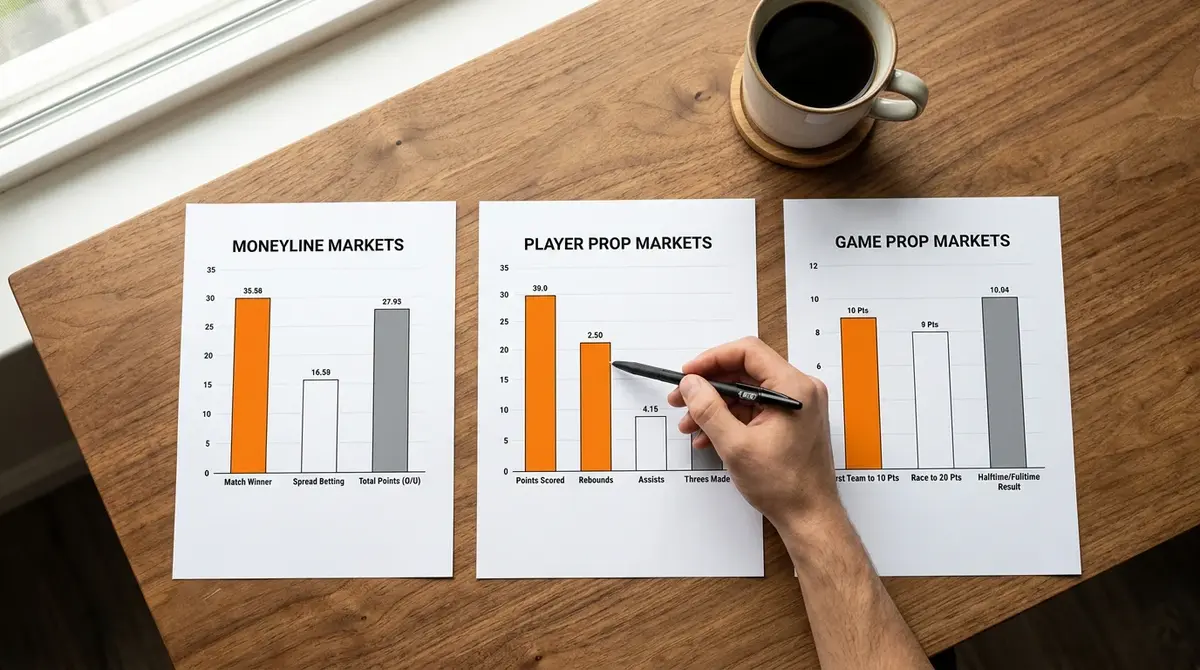
Moneyline betting — picking the outright winner — makes sense in specific situations. If you love a heavy underdog's chances but don't want to bet against the spread (where they'd need to keep it close), the moneyline lets you back them to pull off the upset at plus-money odds. Conversely, heavy favourite moneylines (say, 1.12 on a -12 spread team) rarely offer value because the risk-reward is brutal: risking £100 to profit £12 feels uncomfortable when any NBA team can lose on any given night.
Totals occupy their own analytical space. You're no longer predicting which team wins or by how much — you're predicting the combined scoring environment. Pace, defensive efficiency, rest, altitude, even referee assignments can matter. I find totals useful when I have strong convictions about game flow but no edge on the winner. A live betting angle during slow first quarters often emerges in the totals market before spreads adjust.
Do
- Specialise in one market before expanding
- Track your results separately by bet type
- Consider market efficiency when choosing
- Use totals when you have pace-specific insights
Don't
- Bet moneyline on heavy favourites for "safe" returns
- Switch markets randomly based on gut feeling
- Ignore how different markets price the same information
- Assume spread success translates to totals success
One pattern I've noticed over the years: bettors who struggle with spreads often do better with player props. The analytical skills transfer — evaluating matchups, understanding context, processing information — but props offer market inefficiencies that spreads don't. If you're hitting a wall with spread betting after a few hundred wagers, exploring adjacent markets might reveal where your actual edge lies.
Key Factors That Move NBA Point Spreads
The single biggest leak in my early betting was assuming the spread reflected some objective truth about team strength. I'd see the Nets at -4 and think, "Okay, they're four points better." In reality, the spread reflects a complex mix of factors, and understanding what moves lines is essential before you start trying to beat them.
Public perception drives more line movement than casual bettors realise. The Lakers and Warriors consistently see inflated spreads because their large fanbases bet with their hearts. Bookmakers know this and adjust accordingly. A game that "should" be Lakers -3 based on power ratings might open at Lakers -4.5 because sharps and bookmakers both anticipate where recreational money will flow.
Primary Factors in Spread Setting
Team power ratings form the foundation. Home court adds roughly 3 points to the home team's favour. Recent performance, injuries, rest situations, and travel all layer on top. Finally, anticipated betting patterns influence the opening number and subsequent movement.
Schedule spots matter enormously. NBA teams play 82 games across roughly 170 days, meaning back-to-back games are unavoidable. Academic research pegs the fatigue impact from back-to-back situations at approximately 2.25 points of performance degradation — almost as significant as home court advantage.
Home teams win approximately 60% of NBA games outright. That sounds like a massive edge until you realise bookmakers have known this forever. The home advantage is priced into every spread you'll ever see — your job is identifying when it's overpriced or underpriced for specific matchups.

Injury news moves lines faster than almost anything else. Star player availability can shift a spread 3-5 points within minutes of an announcement. For a deeper look at home court dynamics, I've written separately about how individual arenas create opportunities the flat "3 points" average misses.
Home Court Advantage in Spread Calculations
During the 2022 playoffs, I watched Denver destroy opponents at Ball Arena while barely surviving on the road. The Nuggets' altitude advantage — playing at 5,280 feet where visiting players gasp for air by the fourth quarter — felt like cheating. That experience taught me that "home court advantage" isn't one thing. It's dozens of factors compressed into a single number that barely captures the reality.
The consensus figure among oddsmakers is 3.0 points for home court advantage. Jeff Sagarin's ratings, which bookmakers reference heavily, use this exact number as a baseline. But treating 3 points as universal is lazy analysis. Oklahoma City has demonstrated a home court edge closer to 7 points over recent seasons. Boston and Denver win nearly 80% of their home games. Meanwhile, some teams — particularly those in markets with heavy away-fan attendance — barely benefit from playing at home.
Rest days account for only about 9% of home court advantage. The remaining 91% comes from crowd energy, referee bias (yes, studies document this), travel fatigue for visitors, and familiarity with the arena's sightlines and rims. Sleep quality in team-controlled environments matters more than most bettors credit.
For spread betting purposes, the question isn't whether home court exists — it's whether the line accurately reflects the specific home court in question. When the Nuggets host a team that's flown in from the East Coast on a back-to-back, Denver's structural advantages compound. The generic 3-point adjustment might understate reality by 2 or more points. Conversely, when a Western Conference team plays at Sacramento — whose arena atmosphere is middling and whose altitude is sea level — that same 3-point adjustment might overstate the Kings' home edge.
Playoff basketball amplifies these dynamics. Teams with home court advantage have won 74% of series since 2009, which goes far beyond the regular season's roughly 60% home win rate. Crowd intensity, tighter rotations, and the psychological weight of elimination games all favour the home team more dramatically in the postseason. Spreads during playoffs often reflect this, with home teams seeing extra points added to their lines compared to what regular-season power ratings would suggest.
Injuries, Rest Days, and Line Movement
The fastest I've ever seen a line move was February 2024. LeBron James got ruled out 45 minutes before tipoff, and the Lakers' spread shifted from -2 to +3 before I could refresh my screen. Five points in under a minute. That's the velocity of modern sports betting markets when actionable information drops.
Star player injuries create the most dramatic spread adjustments. A top-10 player being ruled out typically moves the line 3-5 points, depending on the team's depth. But here's what most bettors miss: the adjustment isn't always accurate. Markets tend to overreact to star absences on popular teams (the Lakers, Warriors, and Celtics draw disproportionate public attention) and underreact on smaller-market squads. That asymmetry creates opportunities if you're tracking role player impact and next-man-up situations.
Injury Report Timeline (NBA Rules)
Teams must submit injury reports by 5pm local time the day before each game, with updates required by 1pm on game day. However, game-time decisions often aren't finalised until warmups. For bettors, this means the most volatile line movements happen in the final 2-3 hours before tipoff.
Rest patterns matter in systematic ways the market doesn't always price correctly. That 2.25-point fatigue effect from back-to-back games? It compounds when you factor in travel. A team playing the second night of a back-to-back, having flown cross-country the previous night, faces a steeper decline than one playing consecutive home games. Some models suggest the road back-to-back penalty approaches 4 points under worst-case conditions.
Load management complicates everything. Top players routinely sit out regular-season games to preserve themselves for playoffs, and these decisions often come with minimal warning. Nikola Jokic might be listed as probable right until warmups, then get scratched. Markets adjust instantly when news hits, but getting positioned before that news requires access and speed most retail bettors lack. My approach: avoid betting games where injury uncertainty is high unless the current line offers obvious value regardless of who plays.
The Mathematics of Spread Betting: Break-Even and Edge
Here's the number that changed how I think about betting: 52.4%. That's your break-even win rate at standard -110 odds. Not 50%. Every bet you place at -110 requires you to beat coin-flip odds just to stay flat.
The maths is straightforward. At -110 odds (1.91 decimal), you risk £110 to win £100. If you win 52.4% of the time, your wins and losses balance out after the juice is taken. Win 50%? You're losing money steadily. Win 55%? You're profitable.
Break-Even Calculation at -110
100 bets at £100 stake each, 52.4% win rate:
Wins: 52.4 bets x £91 profit = £4,768.40
Losses: 47.6 bets x £100 lost = £4,760.00
Net: +£8.40 (essentially break-even)
At 50% win rate: 50 x £91 - 50 x £100 = -£450 over 100 bets
Professional bettors rarely sustain win rates above 57-58% against the spread over large sample sizes. A 56% win rate at -110, betting £100 per game over 500 bets, generates roughly £4,800 in profit. These are meaningful returns, but they require thousands of disciplined wagers.
The juice itself varies. If you can consistently bet at -105 instead of -110, your break-even threshold drops to 51.2%. That 1.2% difference across hundreds of bets is the difference between grinding profit and grinding losses. Line shopping isn't optional — it's survival.
Your edge isn't about picking winners. Your edge comes from identifying spots where your assessed probability exceeds the implied probability in the odds, then betting those spots consistently with proper bankroll sizing.
I track every bet with the opening line, the line I got, and my pre-bet assessed probability. After 500+ bets, patterns reveal themselves. Without data, you're guessing. With data, you're refining a process.
Basketball Betting in the UK: Market and Regulations
When I started betting NBA games from London in 2017, basketball felt like an afterthought on UK platforms. The markets existed, but liquidity was thin and lines were often stale copies of American numbers. That's changed dramatically. British gambling now generates £16.8 billion in gross gambling yield annually, with online betting comprising nearly half of that total. Basketball, driven by NBA accessibility via streaming, has become a genuine betting market here.
The UK operates under one of the world's strictest gambling regulatory frameworks. Every operator you'll encounter is licensed by the UK Gambling Commission, meaning your funds are protected and complaints have regulatory backing. The flip side: enhanced scrutiny means quicker account restrictions for winning players and more verification friction.
UK Market at a Glance
Total GGY: £16.8 billion (April 2024 - March 2025)
Online betting share: 46% of total market (£7.8 billion)
Adult participation: 48% of UK adults gambled in the past month
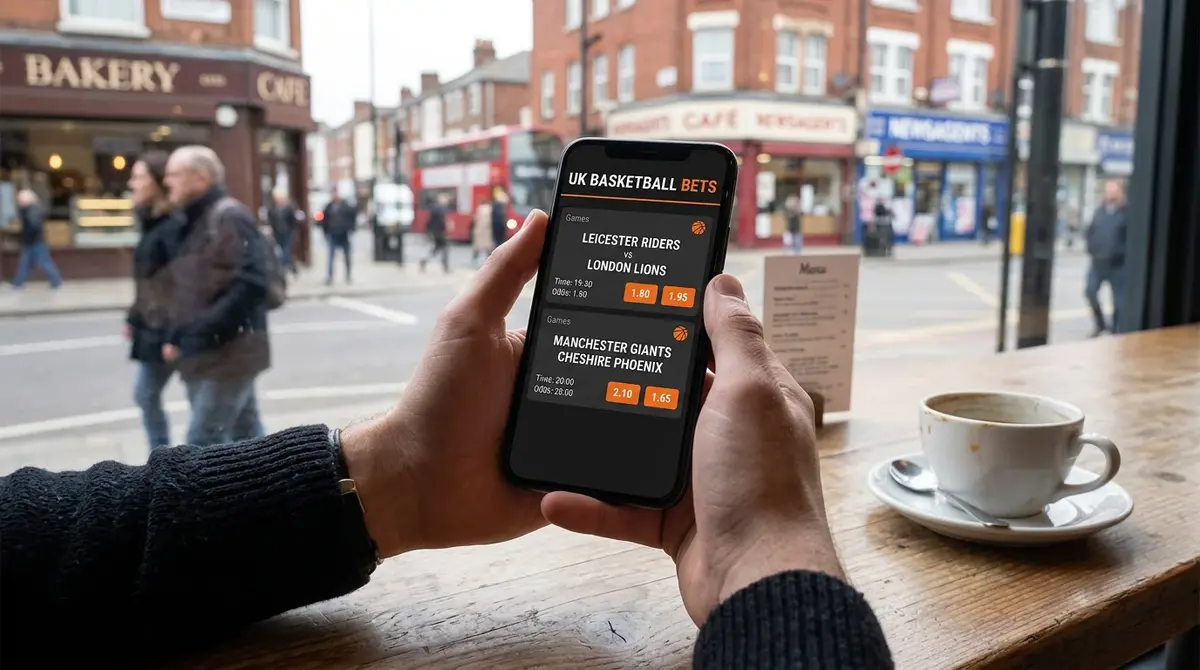
Nearly half of UK adults participated in some form of gambling over a recent four-week survey period. The difference for basketball bettors: we're participating in a market operators haven't yet mastered. American sports generally see less sophisticated lines on UK platforms compared to US markets, which can create edges.
Legal analysis from Clifford Chance described the 2025 reforms as "a decisive shift in UK gambling regulation," positioning Britain as a global leader in responsible gambling. For bettors, this means more protective tools and clearer rules, but also tighter operator scrutiny.
UK-licensed sites offer NBA spreads on every game, typically opening lines 24-36 hours before tipoff. Liquidity has improved enough for reasonable amounts, though large stakes still require splitting across books. For detailed coverage of regulatory requirements and licensing, I've written a separate guide.
2025 UK Gambling Reforms: What Changed for Bettors
April 2025 brought the most significant changes to UK gambling regulation since the 2005 Gambling Act. The headlines focused on slot stake limits, but the real impact cuts deeper.
The Gambling Levy took effect on 6 April 2025, requiring operators to pay a percentage of gross gambling yield into a fund supporting research, education, and treatment. This money had previously come through voluntary contributions — now it's mandatory. Operators will pass some of this cost along through tighter margins.
Key 2025 Regulatory Changes
Gambling Levy: Statutory contribution from operators based on GGY (effective 6 April 2025)
Slot stake limits: £5 maximum per spin for ages 25+; £2 maximum for ages 18-24 (phased April-May 2025)
Marketing consent: Operators must obtain specific opt-in consent by product type and channel (effective 1 May 2025)
Since May 2025, operators can only send promotional content to customers who've actively consented — and that consent must be granular. Agreeing to email promotions doesn't mean you'll receive SMS offers. Parliamentary debate on these changes acknowledged how fundamentally the industry has transformed, with one statement noting that cutting-edge technology has driven "monumental change" in gambling.
For basketball bettors specifically, the 2025 changes have minimal direct impact. Slot limits don't affect sports betting stakes. But the direction is clear: regulators are tightening oversight, and operators are responding with more stringent customer monitoring. Winning bettors can expect faster restrictions and more verification requirements.
Responsible Basketball Betting: Tools and Limits
Three years into my betting career, I hit a rough patch. Chasing losses across multiple platforms, betting amounts I couldn't afford, telling myself the next week would turn things around. It took a brutally honest conversation with my partner to recognise the pattern. I wasn't gambling for entertainment or even profit anymore — I was gambling to escape the anxiety of previous losses.
The statistics are sobering: 30% of young people aged 11-17 in the UK spent their own money on gambling activities in the past year. Problem gambling doesn't announce itself. It creeps in gradually, disguised as enthusiasm or dedication.
Tech policy expert David Sasaki warns that AI is poised to "supercharge the gambling industry" by helping bookmakers fine-tune odds, identify when users are likely to place riskier bets, and target vulnerable customers at their most susceptible moments. Your defensive toolkit needs to match their sophistication.

Every UK-licensed operator provides mandatory responsible gambling tools. Deposit limits cap how much you can add over daily, weekly, or monthly periods. Cooling-off periods let you temporarily block yourself from betting for 24 hours to six weeks. Self-exclusion through GAMSTOP bars you from all UK-licensed gambling sites for a minimum of six months.
Questions to Ask Before Placing Any Bet
- Am I betting with money I can genuinely afford to lose completely?
- Have I analysed this bet, or am I acting on impulse or emotion?
- Would I be comfortable telling someone I trust about this bet?
- Am I trying to win back previous losses?
- Do I have a predetermined stake that fits my bankroll management rules?
I now use deposit limits religiously. My monthly cap is set to an amount that would sting to lose but wouldn't affect my ability to pay bills or save. The forced pause when I hit that limit prevents exactly the kind of spiral I fell into years ago. Betting on basketball should add entertainment value to games you'd watch anyway. If you find yourself watching games solely because you have money on them, or hiding activity from people close to you, those are warning signs worth heeding.
Common Point Spread Mistakes UK Bettors Make
Beyond the emotional discipline covered above, there's a separate category of errors: mechanical mistakes that cost money before you even get to analysis. I've reviewed bet slips for probably fifty friends and acquaintances over the years, and the same mistakes appear constantly — not because people are stupid, but because spread betting has counterintuitive elements that trip up anyone coming from other betting contexts.
The biggest confusion involves terminology. UK bettors know handicap betting from football, but American spread conventions use opposite signs. In UK football handicaps, a negative number against the favourite means they start behind. In American spread format (which most NBA content uses), the negative number shows the favourite must win by that margin. Same concept, inverted presentation. I've watched people back the wrong side because they read -6.5 through football goggles.
Understand Correctly
- Lakers -6.5 means Lakers must win by 7+ for that bet to cash
- Celtics +4.5 wins if Boston wins OR loses by 4 or fewer
- Push at whole numbers returns your stake — it's not a loss
- -110 odds require 52.4% win rate to break even, not 50%
Avoid These Errors
- Treating -6.5 as "Lakers are 6.5 points worse" (it's the opposite)
- Assuming a team's win guarantees your spread bet wins
- Thinking standard odds (-110/1.91) are break-even at 50% wins
- Reading UK handicap format as American spread format
Another common mistake: expecting -110 to be fair odds. The juice means you lose money at 50%. I've met people who couldn't understand why their "50-50" record left them down, genuinely shocked that they needed 52.4% just to stay flat.
Finally, UK bettors often assume the line they're given is "the" line. In reality, spreads vary across bookmakers, sometimes by a full point. Taking Nuggets -5.5 when another site offers -4.5 is leaving money on the table. Comparing prices across multiple platforms can add percentage points of edge over a full season.
Frequently Asked Questions
What is point spread betting in basketball?
Point spread betting is a wager on the margin of victory. Bookmakers assign a handicap to level the playing field: the favourite must win by more than the spread, while the underdog can lose by less than the spread (or win outright) and still cash. If the Celtics are -7.5, Boston must win by 8+ points. Charlotte backers at +7.5 win if the Hornets lose by 7 or fewer, or win outright.
How do I read NBA betting odds in the UK?
UK bookmakers typically display decimal format, where the number represents total return including stake. Odds of 1.91 mean a £10 bet returns £19.10 (£9.10 profit plus your stake). American odds appear as -110 or +110; negative numbers show stake required to win £100, positive numbers show profit on £100 staked. The standard -110 converts to 1.91 decimal or roughly 10/11 fractional.
What does "covering the spread" mean?
Covering the spread means a team's performance beats their assigned handicap. A favourite covers by winning by more than the spread — Lakers -6.5 winning by 10 covers. An underdog covers by winning outright or losing by less than the spread — Pistons +8.5 losing by 6 covers. ATS (Against The Spread) records measure this spread performance, not wins and losses.
What happens if the spread lands exactly on the number?
When the margin equals the spread exactly, it's called a push — your stake is returned with no profit or loss. This is why most spreads include half-points (like -6.5): it's impossible to win by half a point, eliminating push scenarios. In accumulators, a pushed leg is removed and the parlay continues with remaining selections at adjusted odds.
Does overtime count in NBA spread bets?
Yes, overtime counts in standard NBA spread bets unless stated otherwise. The final score after all overtime periods determines the outcome. Games going to overtime often see inflated margins from intentional fouling, which can flip a spread that looked safe in regulation. Always verify specific rules with your bookmaker for proposition bets.
What is the difference between spread and handicap betting?
No functional difference — they're the same concept with different regional terminology. UK betting uses "handicap," American sports betting says "spread." The mechanics are identical: one team gives points, the other receives them. Most modern UK platforms now match American presentation (-6.5 means the favourite must win by that margin) for NBA markets.
How much is home court advantage worth in NBA betting?
The consensus baseline is 3.0 points, but this masks significant variation. Denver's altitude advantage pushes their edge to 4-5 points; Oklahoma City has demonstrated roughly 7 points over recent seasons. Some teams barely benefit from home court. The betting edge comes from identifying matchups where the generic 3-point adjustment over or understates reality.
Building Your Point Spread Betting Foundation
Nine years after that confusing night in Manchester, I still remember the moment spread betting clicked. It wasn't any single insight — it was the accumulation of small understandings that suddenly cohered into a framework. The mechanics, the mathematics, the market dynamics, the discipline. Each piece meaningless alone, powerful together.
Point spread betting rewards patience and process over intuition and luck. The 52.4% break-even threshold isn't forgiving. The juice compounds over hundreds of bets. Sharp money moves lines before you've finished reading the injury report. None of this is discouraging once you accept it — it's simply the terrain you're choosing to navigate.
Start with the fundamentals covered here. Understand what spreads actually represent and how bookmakers build their lines. Get comfortable converting between odds formats so American analysis becomes accessible. Recognise that home court advantage, rest patterns, and injuries aren't just factors — they're the factors that most directly move lines and create betting opportunities.
The gap between recreational bettors and profitable ones isn't prediction skill. It's process discipline: tracking results honestly, shopping lines religiously, sizing bets appropriately, and recognising when you have genuine edge versus wishful thinking. The mathematics don't care about your feelings; they reward consistency.
From here, the path branches. You might explore specific betting strategies that build on these fundamentals. You might find your edge lies in live betting or player props rather than pre-game spreads. The foundation is the same regardless — and you've just built it.
The court is set. The edge is yours to find.
Articles
Written by the editors at pointbetbasketball.com.
