

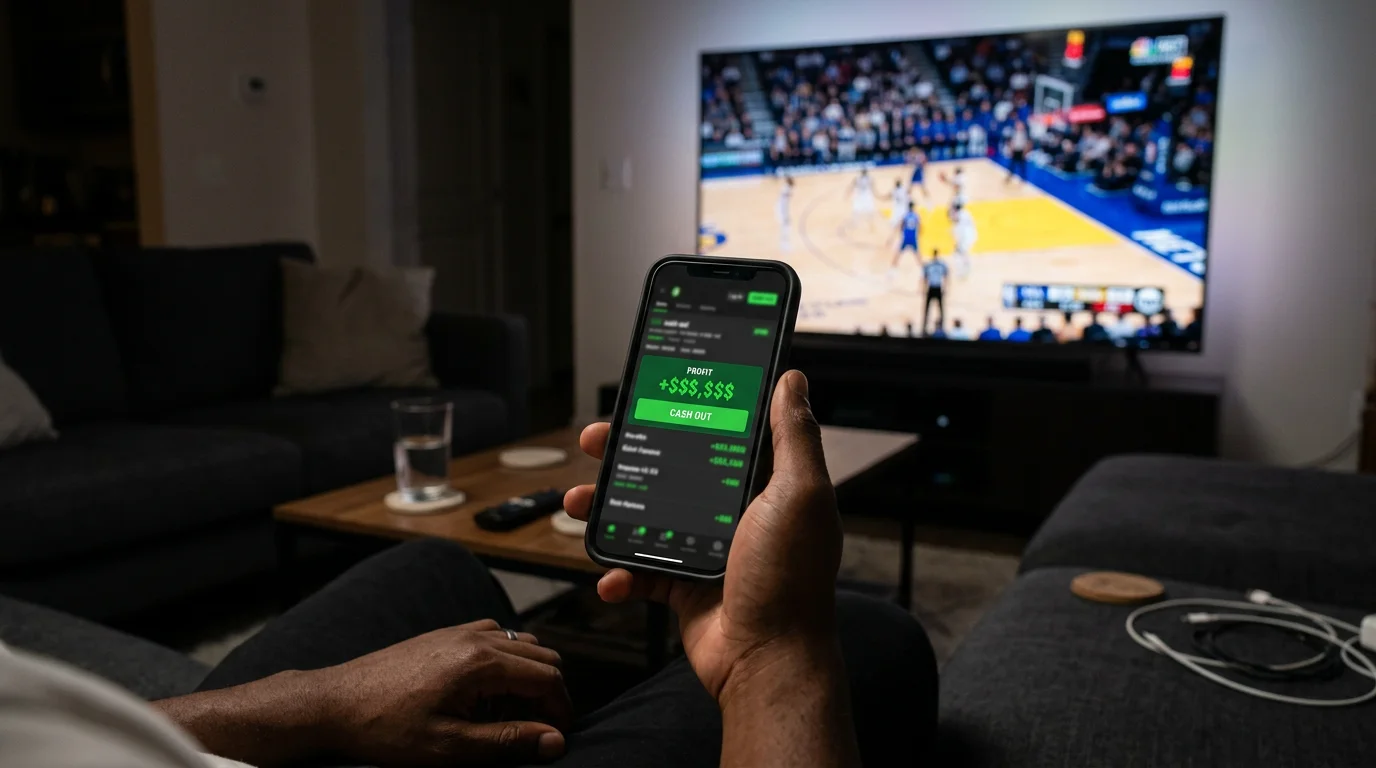
The third quarter was ending, and my bet looked golden. The team I backed led by twelve points with fifteen minutes remaining. The cash out offer sat there on my screen: guaranteed profit, no more sweating, certainty instead of risk. I held. They blew the lead. I lost. For weeks afterward, that declined cash out haunted me. But was I actually wrong to let it ride? That question deserves more rigorous analysis than emotional hindsight provides.
NBA live cash out lets you settle bets before the game ends, locking in profit when ahead or cutting losses when behind. UK bookmakers offer this feature prominently, knowing it appeals to bettors’ risk aversion and desire for control. Understanding when cash out serves your interests – and when it serves the bookmaker’s interests – is essential for using the feature wisely.
The mathematics of cash out are not neutral. Bookmakers build margin into every cash out offer. The question is whether accepting that margin makes sense given the specific game situation and your assessment of remaining probability. Sometimes it does. Often it does not.
How Cash Out Values Are Calculated
Cash out prices reflect the bookmaker’s current assessment of your bet’s probability of winning, minus margin. If your bet is currently estimated at 70% likely to win, the cash out offer will not reflect 70% value – it will reflect something lower, perhaps equivalent to 65% value.
The margin built into cash out exceeds the margin on original bet placement. This is the bookmaker’s incentive to offer the feature – they profit when you use it. The convenience of certainty comes at a mathematical cost. Frequent cash out users systematically surrender value compared to those who let bets resolve naturally.
Cash out offers update continuously during live games as circumstances change. A comfortable lead produces high cash out offers. A collapsing lead produces declining offers. The offers respond to score changes, time remaining, and sometimes to in-game betting action that signals market sentiment.
Some bookmakers offer partial cash out, letting you lock in profit on a portion of your bet while leaving the remainder active. This splits the difference between full cash out and letting everything ride. The same margin principles apply to the cashed-out portion, but partial cash out provides a middle path when you want to reduce exposure without eliminating position entirely.
When Cashing Out Early Makes Sense
Despite the mathematical disadvantage, situations exist where cashing out represents reasonable decision-making.
Changed information that the cash out price has not fully incorporated creates strategic cash out opportunities. If you learn of an injury or tactical change mid-game that damages your bet’s prospects before the live market fully adjusts, cashing out at the pre-adjustment price captures value the market has not yet removed.
Bankroll preservation sometimes justifies accepting cash out margin. If your bet represents an uncomfortably large portion of your bankroll and the game situation has become uncertain, reducing exposure through cash out protects your betting capital. The mathematical cost might be worthwhile when the alternative is psychological distress and potential bankroll damage.
Hedging accumulator exposure through cash out makes sense in specific scenarios. If you have a five-leg acca with four legs already won and the fifth appearing risky, cashing out guarantees substantial profit rather than risking everything on the final leg. The certain profit might be lower than the potential payout, but it eliminates catastrophic miss scenarios.
Life circumstances sometimes override optimal mathematical play. If you need the money for an upcoming expense, or if the stress of watching the game complete is affecting your wellbeing, cashing out and moving on might be the right choice for reasons that pure expected value analysis cannot capture.
When Cashing Out Costs You
Most cash out usage surrenders value unnecessarily. Recognising these situations helps resist the temptation to lock in prematurely.
Cashing out profitable positions in games that remain likely to win destroys expected value. If your team leads by ten with eight minutes remaining, the probability of winning remains high. The cash out offer will be attractive in absolute terms but poor in relative terms – you are selling a bet worth more than you are receiving for it.
Emotional response to short-term game flow drives poor cash out decisions. Your team allows a quick 6-0 run, and suddenly the cash out button looks appealing. But basketball games feature runs constantly – momentum shifts do not necessarily predict final outcomes. Reacting to normal variance rather than fundamental probability changes is a losing approach.
The fear of loss feels worse than the pleasure of equivalent gains – this is loss aversion, and bookmakers know it drives cash out behaviour. When your winning bet faces any adversity, the desire to protect profit intensifies beyond what rational probability assessment would suggest. Awareness of this bias helps resist unnecessary cash outs.
Systematic cash out use – always cashing out when profitable – creates a built-in disadvantage. The accumulated margin surrendered across many cash outs significantly impacts long-term results. If you find yourself cashing out most winning positions, you are essentially paying extra commission on every successful bet.
A Framework for Cash Out Decisions
Structured thinking about cash out prevents emotional decision-making. This framework helps evaluate each situation on its merits.
First, estimate the current probability that your bet wins. Not based on how you feel, but based on the actual game situation – score, time remaining, which team has momentum. If you think your bet is 75% to win, that becomes your baseline.
Second, calculate what the cash out offer implies about probability. If the original odds were 2.00 (50% implied) and the cash out returns 0.80 of your stake plus 0.40 profit, the total return is 1.20 per unit. Working backward, this implies roughly 83% win probability if fair (1 / 1.20). But after margin, maybe they are pricing you at 75%.
Third, compare your probability estimate to the offer. If you think your bet is 80% to win but the offer implies 75%, you have edge by holding. If you think it is only 65% but the offer implies 75%, cashing out captures value.
Fourth, consider non-mathematical factors. Bankroll pressure, emotional state, and information asymmetry all legitimately affect the decision beyond pure expected value. Include these, but do not let them dominate analysis.
For context on how cash out options fit within the broader NBA betting landscape, the point spread betting guide explains the underlying markets where cash out decisions arise.
Articles
Written by the editors at pointbetbasketball.com.
